
Temporary Email and Permanent Email Are Not Rivals
Stage: the form asks for an address. In control: you, for exactly one second.
1. The choice is about what happens later
Both kinds of address do the same thing at the moment you use them: they receive a message. Everything that separates them happens afterwards, when you have already moved on and stopped paying attention.
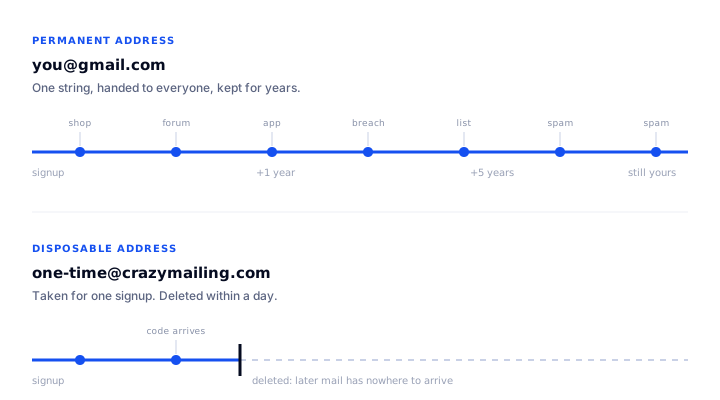
A permanent address stays. It sits in the database of the shop, in the export that the shop's marketing agency took last spring, in the backup that a contractor kept on a laptop, and in whatever ends up on a forum three years from now when one of those parties is breached. Nothing about this requires anyone to behave badly. The address simply persists, and every copy of it keeps working.
A temporary address does not stay. The mailbox exists for a day, the message arrives inside that day, and then the mailbox and its contents are deleted. Copies of the string survive in the same databases, but they point at nothing.
2. What the permanent address is actually good at
It is worth being precise here rather than selling. A permanent address is the right tool whenever you will need to prove, later, that the account is yours.
Password resets are the obvious case. So is anything that involves money, delivery, a contract, a warranty, a subscription you intend to keep, or a service whose support team will ask you to write from the address on file. In every one of those, losing access to the mailbox means losing the account, and a mailbox that deletes itself by design is a bad place to keep that responsibility.
This is not a small category. It covers your bank, your government portal, your employer, your domain registrar, the shop that will ship a parcel next week, and the two or three services you would be genuinely upset to lose.
3. What the permanent address is bad at
Everything else, and "everything else" is most of the forms you meet.
The gate that demands an address before showing a price. The download that requires registration. The forum you will read once. The trial you will not convert. The marketplace listing that needs a reply. The webinar you want the recording of. None of these will ever need to prove your identity, and all of them will keep your address for as long as they exist.
There is a second cost that is easy to miss. Every place holding your permanent address is also a place where that address can be matched with the others. Two databases with the same string in them describe the same person, and the linking happens without anyone deciding to do it.
4. Where a temporary address fits exactly
The pattern that matters is one-time verification. A code or a link arrives, you use it, and the mailbox has no further purpose. That is the shape of most signups, and it is the shape a disposable address is built for.
The practical test is one question, and it takes no thought at all: if this inbox is gone tomorrow, does anything break? If the honest answer is no, the address does not need to outlive the signup.
Reading the reverse way is just as useful. If the answer is yes, something breaks, then no amount of convenience justifies a mailbox that deletes itself, and you should reach for the permanent one.
5. The awkward middle
Some accounts sit between the two, and pretending otherwise would be dishonest.
A shop you buy from twice a year is a real example. The order confirmation matters for a week, and after that the address only receives campaigns. A forum account you might return to is another. Here the honest answer is a third option rather than either of the first two: a permanent address that is not your main one, or a catch-all domain of your own where every service gets its own string. Both are covered elsewhere on this site, in a catch-all domain of your own and in email masking and relay services.
What does not work is using one permanent address for everything and hoping that the shops which had it in 2019 have since deleted it. They have not.
6. What a signup form thinks about your choice
Forms are not neutral about this, and it is worth knowing before you are surprised by a rejection.
Many services check the domain against public lists of disposable providers, and a rejected address is not a bug in the service or in this one. It is a business decision on their side, described in more detail in how disposable email detection works. Sites with real fraud pressure block hardest: payments, marketplaces, anything giving away credit on signup.
Sites gating a download or a newsletter rarely bother. That asymmetry maps neatly onto the advice above, because the services that block are usually the ones where you wanted the permanent address anyway.
7. What "deleted" means here, in actual numbers
The word temporary does a lot of work in this industry and is rarely backed by anything, so here is the machinery on this site, stated as numbers rather than as a promise.
Without an account, one mailbox exists at a time and it is removed twenty four hours after you last touched it. Asking for a different address does not queue the old one for expiry, it deletes it at that moment, which is why it is worth copying anything you still want first. Signing in changes three of those numbers: ten mailboxes can exist at once instead of one, the clock becomes seven days, and it restarts from every sign in, so an address survives for as long as you keep coming back. On top of all of that sits a ceiling that nothing overrides: an individual message is kept for thirty days at most, however active the account is.
The removal itself is a sweeper that runs continuously rather than a promise to tidy up eventually. It takes expired messages first and expired mailboxes second, in batches, with a lock ensuring exactly one process is doing the work. Before it deletes anything it collects the storage keys of the attachments involved, so the files themselves are removed from storage rather than left behind as orphans that nobody can find and nobody deletes. Nothing is archived and there is no backup anyone could restore from, including us.
That last clause is the whole difference between the two columns. A permanent address is durable because somebody keeps paying to keep it. A temporary one is temporary because the deletion is a mechanism that runs whether anyone remembers it or not.
8. The two kinds of address even look different
A permanent address is chosen once and typed for a decade, so people optimise it for memorability and pronunciation. That is the right optimisation for something you will read aloud over a phone.
A disposable one is optimised for two other things. First, it is generated to look like an ordinary mailbox belonging to an ordinary person: a pair of plain words, or a given name joined to a family name, with four digits on the end. What it deliberately avoids is any of the vocabulary that announces the category, because an address containing temp, trash or a number of minutes gets refused by a human reading a form long before any automated list has an opinion.
Second, those four digits are a security decision rather than decoration. An inbox that belongs to no account is reachable by whoever holds the string, which is a defensible trade only while the string cannot be guessed. Four digits on the end put the number of possible names on each domain in the tens of millions. Two digits would have left a few hundred thousand, a range that a script exhausts over one afternoon, reading whatever it finds along the way.
9. The two mistakes are not symmetrical
Getting this wrong in the permanent direction costs you slowly. An address you did not need to give out sits in one more database, joins one more profile and produces a little more mail every year. It is a cost you never feel arriving.
Getting it wrong in the temporary direction costs you all at once, and quietly. Mail sent to a mailbox that has been deleted is not returned to the sender: it is accepted and discarded, because a service that answered honestly would be publishing which of its addresses currently exist to anyone scanning them. So the company's records say the message was delivered, your inbox never existed, and no notification is generated on either side.
Which is why the question in section four is worth answering honestly rather than optimistically. The temporary column is generous, but the failure at its edge gives you no warning at all.
The handover
If the form in front of you belongs in the temporary column, the address on the front page is ready before you finish reading this sentence. If you want to know what the receiving side sees when that address arrives, how disposable email detection works explains it from their side of the wire. If you are wondering whether the mail can be traced back to you, can disposable email be traced answers it without hedging. And if the account you are creating turns out to matter after all, what a breach does with your address is the argument for not reusing the permanent one everywhere.
Read next
How Free Disposable Email Is Paid For
Nobody hosts mail for free out of kindness. The four business models behind throwaway inboxes, and which one this site runs on.
How Disposable Email Detection Works
Blocklists are only the first check. MX lookups, SMTP probes, domain age and scoring, explained by a service that gets detected.
Disposable Domain Blocklists
Who maintains the public lists, how a domain lands on one, how long it takes, and why asking to be removed never works.